The Squirrel monkey (Saimiri) is a primate native to the tropical forests of Central and South America (Newquay zoo & animal wildlife park, 2016). They habitat the high canopies of the forests very rarely venturing to the low floor of the forest (Newquay zoo & animal wildlife park, 2016).
Per IUCN data, Squirrel Monkeys are a least concerning species of going extinct. There are still threats that risk this species of becoming under threat and having to face the risk of extinction (Newquay zoo & animal wildlife park, 2016). Habitat loss is causing the natural environment of the Squirrel Monkeys to slowly reduce. The Squirrel Monkeys are largely distributed and well populated, the total estimated distribution was 35,000 in 2006 around Central and South America which makes them fit into the criteria of least concerned (Squirrel monkey, 2006).
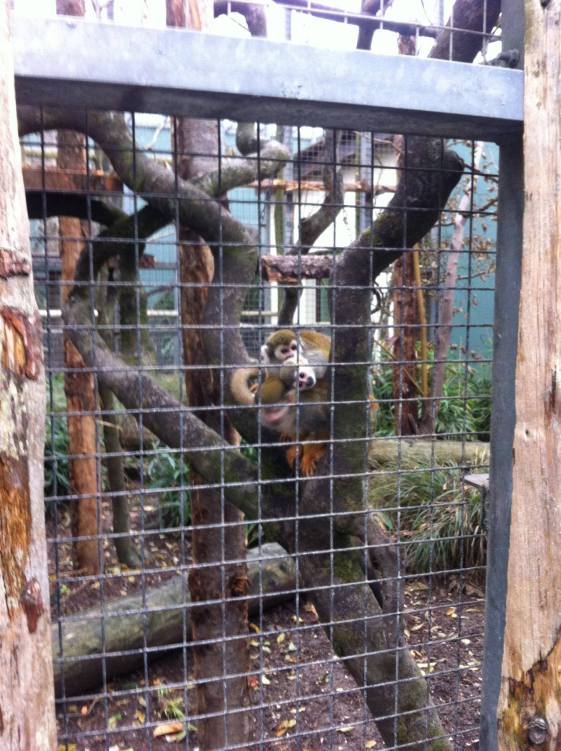
Male Squirrel Monkeys have a distinct grey crown of fur where as a female has a very dark crown. They are sexually dimorphic during reproductive seasons (Squirrel monkey, 2006). Males will begin to gain weight in the two months coming up to the breeding season allowing himself to look larger or fatter in the attempt to successfully breed (Squirrel monkey, 2006).
Females become sexually mature at the age of three and males at the age of five, the gestation period is in between 150 to 170 days (The simian society – squirrel monkey, no date). Only the mother cares for the young with it clinging to her back and being carried until it becomes independent (The simian society – squirrel monkey, no date).
Young Squirrel Monkeys with begin to wean of the mother’s milk to solid foods only after 6 weeks and from there will progressively explore the area around it becoming aware of how to climb the trees and what to eat (The simian society – squirrel monkey, no date). Young offspring are known as one of the most independent at such a young age in comparison to all other primate species (MonkeyWorlds, no date).
There are 13 Squirrel Monkeys located at Newquay Zoo with six of those being females and seven males (Newquay Keeper, 2016). Three of the females are not sexually active in captivity, one is too old to reproduce, one recently has an offspring and lost it and one is in full health but for an unknown reason will not reproduce (Newquay Keeper, 2016).
In most primate species that live-in groups, there will always be aggressive behaviour for numerous reasons. Studies of primates at Zoo in Dutch in 1970 showed after observation that a pair of two male chimpanzees (Sci name) fought fiercely and then after a while appeared to embrace once more in a very peaceful manner now known as a behaviour called reconciliation (Conniff, 2003).
Squirrel Monkeys communicate through visual signs and social behaviour, but the focus of this study is to observe the aggression of the adults in comparison to the adults with young (Living Links / University of Stirling, 2009). This is to try and understand where the young come into the status of hierarchy within a group when still in its first few weeks of life and beginning to explore of its mothers back around the enclosure at Newquay Zoo (Newquay zoo & animal wildlife park, 2016).
Method
Four people will be observing the troop of Squirrel Monkeys at Newquay Zoo, one person will be stood on a corner of the enclosure so that the entire enclosure and Squirrel Monkeys are visible (Home, 2005). The observation will be a continuous scan for 20 minutes recording any signs of aggression shown in Table 1.
Table 1. Ethogram and recording table used in observation to record behaviours.
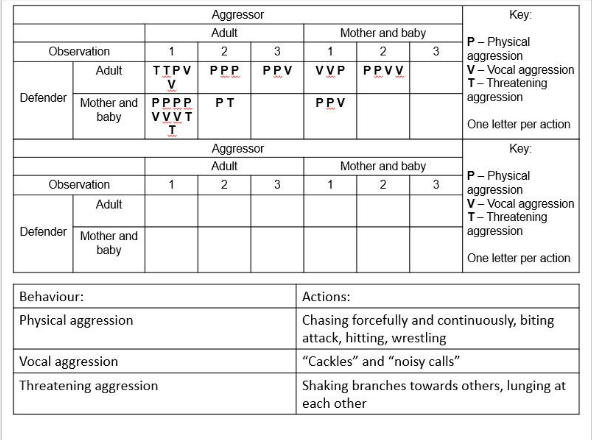
The aim of the study is to investigate who is more aggressive however the type of aggression will also be recorded to understand more thoroughly how the individual was in fact aggressive. The observation will be repeated a total of three times with five-minute break periods in between for ethical purposes on the observer’s behalf. The null Hypothesis for this observation is that there is no significant difference in the aggressive behaviour depending on if they are carrying young or not.
Results
After evaluating the data collected it is apparent that the adults without young are more aggressive, the adults with young show less than half of the aggression portrayed by those without shown in Figure 1. Using Chi squared, the statistical analysis resulted in a significant value of 4.5 and a P value of 3.841 because the significant value is higher than that of the P value this means there is a significant difference in the amount of aggressive behaviour displayed by adults rather than adults with young.
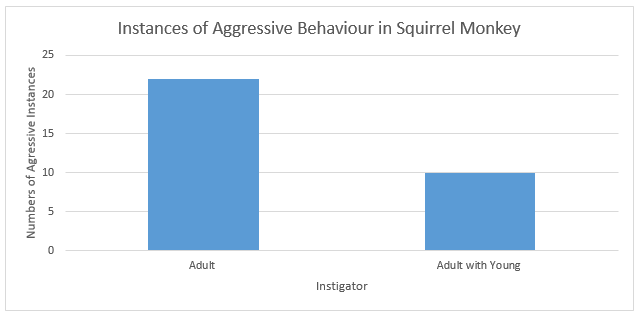
Figure 1. The results of the observation of Squirrel Monkeys show that adults with young were more aggressive than those with young.
Discussion
When analysing the data, it becomes clear that the adults without young are more inclined to behave aggressively than those with young. In the time that the survey was completed the Zoo keepers of Newquay Zoo fed them at 2:30 which was their protein feed of the day which consisted of a scatter feeding method of mealworms (Zookeeper’s). This event could be the entire reason for all aggression shown if not some. The competitive behaviour displayed was a range on vocal, threatening and physical shown in Table 1. From the data collected we could see that the threatening behaviour was used more than actual physical aggression, as Squirrel Monkeys are group foragers they can sometimes get to close to each other and become defensive about the food (Living together Capuchin and squirrel monkeys, no date).
Squirrel Monkeys are not known to perform other behaviours like Capuchin’s (Cebinae), they would groom each other regularly in comparison to troops of Squirrel monkeys that do not regularly groom each other. Grooming is known to help strengthen relationships in groups which may be why there is so much aggressive behaviour via the adults as they do not have such a hierarchy or family like living situation as larger animals such as the Capuchin’s (Living together Capuchin and squirrel monkeys, no date).
Whilst foraging the Squirrel Monkeys are quite thorough and spend a large amount of time uncurling leaves and investigating the area around them ensuring they have not missed any food (Living together Capuchin and squirrel monkeys, no date). The intense foraging could also put a strain on the relationship between a troop if they wanted into another Squirrel Monkey’s area of foraging for food. Food seems to have a large factor to play in the behaviour of a troop, the fear of potentially not being able to feed seems to override any behaviour that would show the Squirrel Monkeys have some form of community relationship.
References
Conniff, R. (2003) Rethinking Primate aggression. Available at: http://www.smithsonianmag.com/science-nature/rethinking-primate-aggression-86813532/ (Accessed: 27 November 2016).
Home (2005) Home. Available at: https://animalcorner.co.uk/animals/squirrel-monkeys/ (Accessed: 27 November 2016).
Living Links / University of Stirling (2009) Living links to human evolution – squirrel monkeys behaviour. Available at: http://www.educationscotland.gov.uk/images/squirrel_monkey_behaviour_tcm4-669207.pdf (Accessed: 27 November 2016).
Living together Capuchin and squirrel monkeys (no date) Available at: http://www.living-links.org/wp-content/uploads/2012/05/SaimiriCebusspeciesComparison20121.pdf (Accessed: 27 November 2016).
Monkey Worlds (no date) Squirrel monkey. Available at: http://www.monkeyworlds.com/squirrel-monkey/ (Accessed: 26 November 2016).
Newquay zoo & animal wildlife park, Newquay, Cornwall, south west UK (2016) Available at: http://www.newquayzoo.org.uk/animals-plants/animals/details/monkey-squirrel-2 (Accessed: 26 November 2016).
Primate Factsheets: Squirrel monkey (Saimiri) Taxonomy, morphology, & ecology (2006) Available at: http://pin.primate.wisc.edu/factsheets/entry/squirrel_monkey (Accessed: 26 November 2016).
The simian society – squirrel monkey (no date) Available at: http://www.simiansociety.org/nonhuman-primate-species/squirrel-monkey/ (Accessed: 26 November 2016).
All photos taken by Kaitlin Flood
 Site Title